


Surface preparation:
• Widen the cracks until a minimum opening of 0.5 cm is achieved, with a depth of between half and twice their width.
• Apply a joint primer if necessary.
• For porous substrates, apply a primer to the edges of the crack using Parafix, Pegafix or Vernac diluted with 10 per cent Thinner 22.
• Pre-treat PVC with Primer 44 HS. For metal and glass, use diluted Noxyde.
Application :
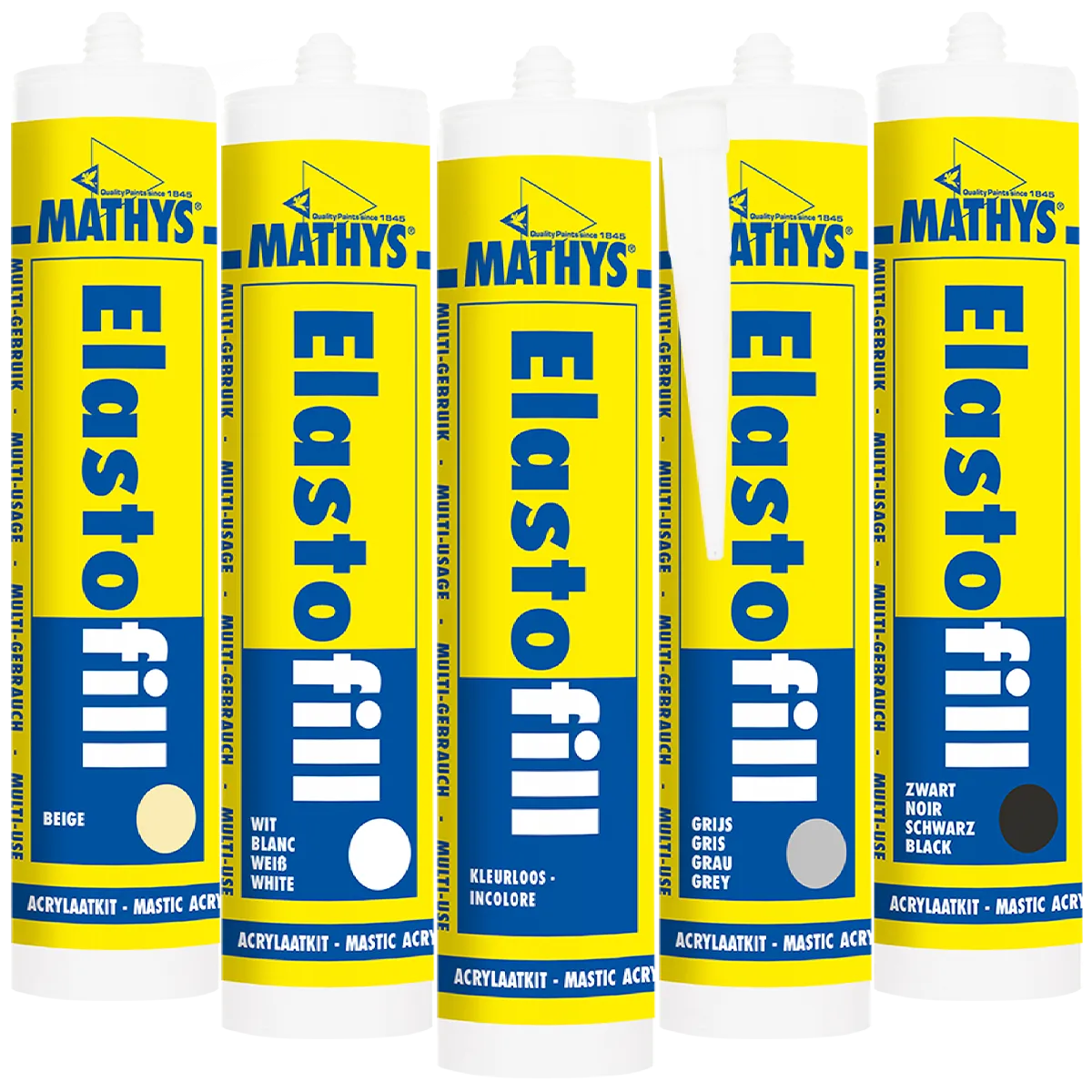
• Apply Elastofill using a cartridge gun, a trowel, a putty knife or a notched trowel (notched joints with a thickness of 3 mm).
Application conditions:
• Temperature above 5 °C.
• Maximum relative humidity of 80 per cent.
• Substrate temperature at least 3 °C above the dew point.
• Drying time (at 20 °C and 50 per cent relative humidity, for a thickness of 8 mm):
• Touch-dry: 3 hours.
• Handleable: 8 hours.
• Recoatable: after 1 day.
• Fully cured: approximately 1 week.
Coverage:
• For a joint 10 mm wide and 15 mm deep, one cartridge is sufficient for approximately 6 running metres.
• Apply the sealant to a maximum wet film thickness of 10 mm.
• Actual consumption depends, in particular, on the porosity and roughness of the substrate, as well as on material wastage during application.
Overcoating:
• Elastofill can be overcoated with the acrylic paints Murfill, Paracem, Paracem Semi-Gloss, Pegacryl and Pegacryl Satin, as well as with solvent-based alkyd lacquers such as Porisol and Pegatex.
• For Paracem and Pegamat paints, a coat of Porisol must be applied first.
Cleaning of equipment:
• Clean tools and remove splashes with water.
• Once dry, Elastofill can be removed mechanically or softened using a synthetic thinner, then removed by rubbing or scraping.
Storage:
• Minimum shelf life of 2 years from the date of manufacture for unopened cartridges, stored in a dry place, protected from frost and direct sunlight, at a temperature between 5 and 35 °C.


Reviews
There are no reviews yet.